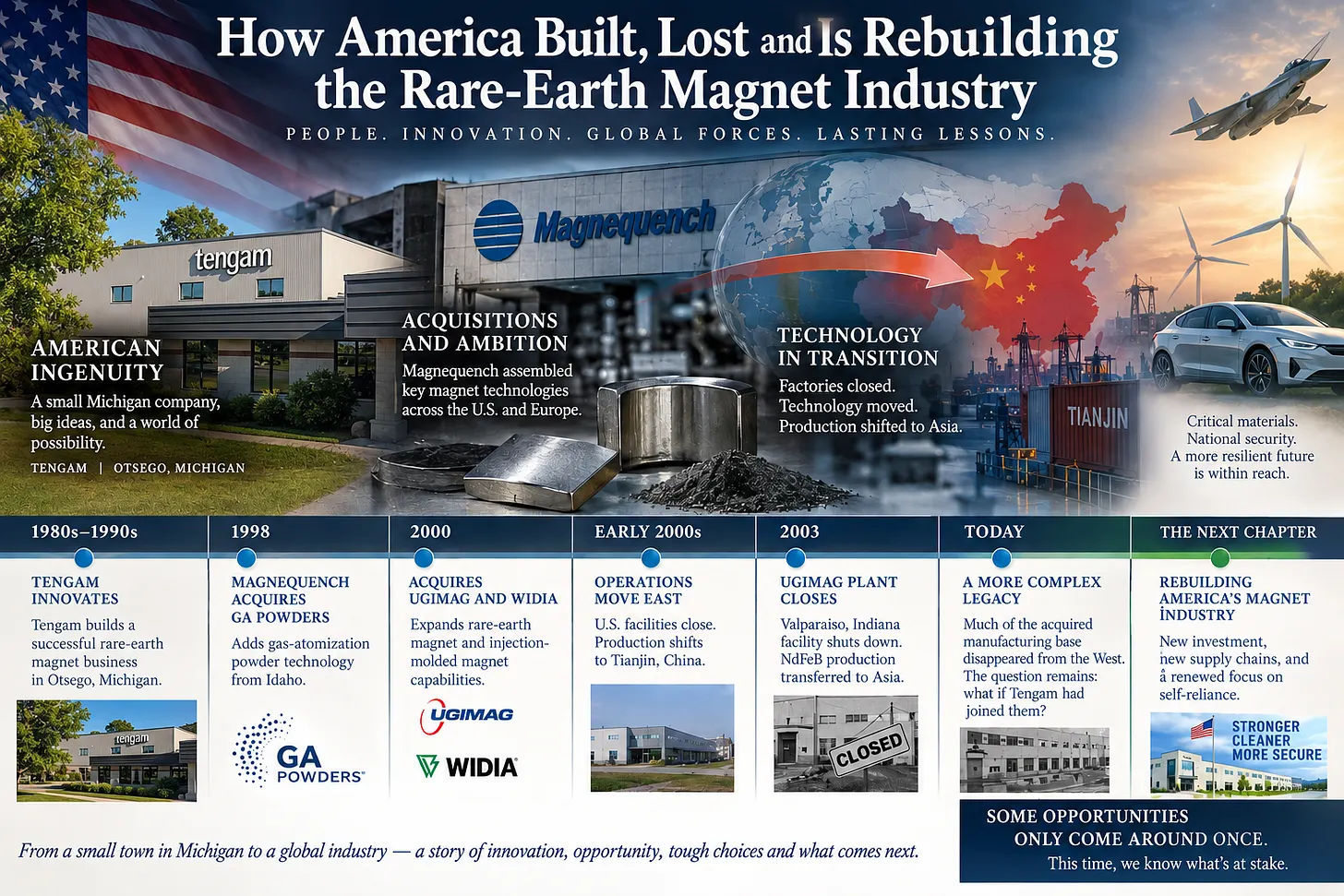
We built it. We watched much of it leave. And now we’re trying to build it again.
Apparently, America has “discovered” rare earths. If you listen to the discussion in Washington today, you could easily come away with the impression that the United States suddenly woke up and discovered that rare-earth elements, permanent magnets and the materials required to manufacture them are important. They are important, but they aren’t new, and America’s involvement with them certainly isn’t new. The United States once stood at the center of the rare-earth world. We developed important technologies for separating rare earths. We learned how to produce high-purity rare-earth metals. We operated what became the dominant rare-earth mine in the world. American researchers helped invent the strongest family of permanent magnets ever developed, American companies learned how to manufacture those materials at commercial scale, and an entire network of American companies turned them into magnets. I have spent most of my life inside that industry. Tengam Engineering has been manufacturing injection-molded permanent magnets in Otsego, Michigan, for more than fifty years. We injection molded ferrite magnets and samarium-cobalt magnets, and beginning in 1986, started working with Delco Remy/Magnequench neodymium iron-boron powders (NdFeB) and developed what Tengam identifies as the world’s first polymer-bonded, injection-molded NdFeB magnet. So, when I hear people talk today about rebuilding an American rare-earth magnet industry, my reaction is a little different from that of someone discovering the subject for the first time. We aren’t trying to invent an American rare-earth industry. We’re trying to rebuild one. To understand what that means, we need to remember what we once had.
Before Mountain Pass, There Was Ames
One of the roots of the modern American rare-earth industry runs through Iowa. During World War II, Frank Spedding and researchers at Iowa State participated in the Manhattan Project. After the war, Spedding became enormously important in rare-earth science, particularly through the development of ion-exchange separation techniques. Rare-earth elements present an unusual chemical problem. They are separate elements, but their chemical behavior is sufficiently similar that separating one from another can be extremely difficult. John Croat later described Ames Laboratory as becoming essentially the world’s major center for rare-earth research, with significant quantities of research-grade rare-earth metals available there. Croat wasn’t simply a magnet scientist who stumbled onto a rare-earth material years later. He was trained in this world. He earned his graduate degrees at Iowa State, studied rare-earth metallurgy, and conducted early research involving the preparation and characterization of rare-earth metals. Then General Motors hired him. That connection, from Ames to Croat to GM to Magnequench, is one of the threads running through this entire story.
Mountain Pass Changes the World
In 1949, an extraordinary bastnäsite rare-earth deposit was discovered at Mountain Pass, California. By 1966, the U.S. Geological Survey says Mountain Pass had become the paramount source of rare earths in the world. USGS describes a Mountain Pass era lasting from roughly 1965 through 1984, followed by a transition period and then what it calls the “Chinese era” beginning around 1991. That chronology is worth remembering. China did not always dominate rare earths. For a significant period, the United States did. Mountain Pass and advances in separation technology helped make commercial quantities of individual rare-earth elements increasingly available, which in turn made entirely new applications possible. USGS notes that commercial quantities of a broad range of individual rare-earth metals became available by the late 1950s and early 1960s. One of those elements was samarium, and its history complicates some of the ways the American rare-earth story is told today.
Samarium Was Already Here
Samarium-cobalt represented one of the first great leaps in permanent-magnet technology. It was expensive, but it was commercially available in the United States and elsewhere. I know that from something considerably more tangible than a historical chart: Tengam used it. We injection molded SmCo powder that was blended with nylon here in Michigan. The major problem Tengam encountered with SmCo was sitting right there in its name: cobalt. The cobalt supply and price crisis of the late 1970s dramatically changed the economics of cobalt-containing materials. For a company molding SmCo magnets, this wasn’t an interesting commodity chart. It affected whether the material made economic sense. Tengam eventually transitioned away from injection-molded SmCo/nylon. At almost the same time, researchers were asking a much larger question: Could we obtain rare-earth-magnet performance without depending upon cobalt? General Motors was asking the same question.
GM Goes Looking for a Better Magnet
The timing wasn’t accidental. The 1973 oil embargo had dramatically increased energy costs, and automobile manufacturers were under pressure to improve fuel economy. Permanent magnets offered one route toward smaller, lighter and more efficient electric motors. Croat later described the mission of GM’s Magnetic Materials Group clearly: develop a lower-cost, high-performance rare-earth/iron permanent magnet without expensive cobalt. He began experimenting with rapidly solidified rare-earth/iron alloys using melt spinning. Then, in 1982, Croat and his GM colleagues identified the Nd₂Fe₁₄B intermetallic phase. At almost the same time, Masato Sagawa and his colleagues in Japan independently discovered essentially the same compound through a different processing route. Croat’s work led toward rapidly solidified powder and bonded magnets, while Sagawa’s work led toward sintered NdFeB. Croat himself describes the independent discoveries and the development of rapidly solidified powder suitable for bonded magnets. The modern rare-earth magnet industry had arrived. There is another piece of this history that seems particularly relevant today. When GM encountered problems in the supply chain, its researchers worked on solving them. Croat’s foundational NdFeB work was underway in 1982 and 1983. In July 1984, GM filed Ram A. Sharma’s patent application for metallothermic reduction of rare-earth oxides. The patent specifically addressed the production of rare-earth metal, including neodymium, for the emerging NdFeB industry. There is an important distinction here. GM wasn’t inventing rare-earth separation. Rare-earth elements could already be separated through established chemical processes. The problem Sharma was attacking was farther downstream: turning separated rare-earth material into a useful metal economically. A mine isn’t a supply chain. Ames had rare-earth separation and metallurgical expertise. Mountain Pass supplied rare-earth material. GM possessed world-class industrial research. Croat understood rare-earth metallurgy. Other GM researchers developed processes aimed at making these materials commercially practical. This ecosystem helped create the invention AND innovation.
From Discovery to Commercial Production
The speed at which all of this happened is remarkable. Croat says GM quickly discovered that rapidly solidified NdFeB powder could be ground, mixed with epoxy and compression molded into useful permanent magnets. Delco Remy became interested almost immediately. A prototype melt spinner was built in late 1983. During 1984 and 1985, the difficult work of converting laboratory melt spinning into a repeatable, high-volume manufacturing process took place. Magnequench was established in Anderson, Indiana, in 1986, and commercial powder sales followed in 1987. I, at only 12 or 13 years of age, was able to see this all in person. I am 100% certain that this would not happen today! Think about that timeline for a moment. Discovery in 1982. Prototype equipment in 1983. Process development in 1984 and 1985. Production equipment in 1986. Commercial powder in 1987. Apparently, nobody told those guys that industrializing a completely new magnetic material was supposed to take decades.
Tengam Was There
This is where the national history intersects directly with my own. Tengam already understood injection-molded magnets. We had molded ferrite and SmCo/nylon. Then Magnequench powder became available. We began working with it in 1986. Instead of compression bonding the powder with epoxy, we developed thermoplastic compounds that could be injection molded into complex magnet geometries. Tengam identifies the result as the world’s first polymer-bonded injection-molded NdFeB magnet. The timing made perfect sense. The cobalt crisis had damaged the economics of SmCo, while NdFeB offered remarkable magnetic performance based primarily on neodymium, iron and boron. GM’s rapidly solidified process produced a powder particularly useful for bonded magnets. We transitioned as did much of the industry.
America Actually Had a Magnet Industry
This is another fact that seems to have been misplaced somewhere along the way. America didn’t merely mine rare earths. We manufactured permanent magnets. Walt Benecki’s historical industry work identified 19 U.S. permanent-magnet manufacturers in 1995. These companies weren’t all doing the same thing. Some manufactured ferrite, some Alnico, some SmCo, some NdFeB and some bonded magnets. Several operated across multiple material families. The list included Arnold, Crucible, Kane Magnetics, Permanent Magnet Company, General Magnetics, Ugimag, TDK, Hitachi Metals, Electron Energy, Dynacast, Thomas & Skinner, Magnequench, Tengam, Magnet Applications, Electrodyne, RJF, Magnum, Magnetic Specialty and Flexmag. I remember roughly ten to twelve companies competing in the bonded and injection-molded portion of the market alone. This was an ecosystem of people who understood powder, metallurgy, polymers, tooling, orientation, sintering, melt spinning, coatings, magnetization, magnetic circuits and applications. Manufacturing knowledge doesn’t reside entirely in patents. A patent can tell you what someone invented. It generally won’t tell you why cavity number three won’t fill correctly on Tuesday morning. That knowledge resides in people.
The Center of Gravity Moves
Outside our little corner of Michigan, the numbers were changing rapidly. Mountain Pass had dominated global rare-earth production from the mid-1960s through the mid-1980s, but Chinese production increased dramatically beginning in the mid-1980s. By 1999 and 2000, USGS reported that more than 90 percent of the separated rare earths used in the United States were imported either directly from China or from countries using Chinese feedstocks. USGS was also remarkably direct about what it saw happening. Its 2002 report warned that the United States was in danger of losing its longstanding leadership in rare-earth technology as processing expertise and applications knowledge migrated toward Asia. That warning was written more than two decades ago.
GM Sells Magnequench
In 1995, General Motors decided Magnequench was no longer core to its business. Croat later described the sale himself. NdFeB had become commercially successful, particularly with the explosive growth of computers and peripherals, but GM was divesting businesses. Magnequench was sold to an investor group involving Archibald “Archie” Cox Jr.’s Sextant Group and Chinese investors including San Huan New Material and China National Non-Ferrous Metals. The ownership history after the sale is considerably more complicated than the shorthand version usually told today. Cox wasn’t a magnet scientist. He was an international investment banker. He had spent decades in finance before establishing Sextant Group, a financial advisory and private-equity business, in 1993. He then spent approximately a decade running Magnequench. SEC records show him as president and CEO from October 1995 through August 2005. That makes Magnequench an unusual chapter in Cox’s career. He wasn’t primarily a magnet executive who later moved into finance. He was a financier who became the head of one of the world’s most important magnetic-material companies. Exactly how Cox and Sextant originally became connected with the Chinese investors remains one of the unanswered questions in this history.
The Ownership Story Wasn’t Static
The Chinese involvement was real, but the ownership structure changed. Contemporary reporting from January 1997 shows Hong Kong-listed Onfem Holdings acquiring 62 percent of a holding company called MQ Holdings. MQ Holdings’ sole asset was a 60 percent interest in Magnequench. Onfem acquired 47 percent of MQ Holdings from China National Non-Ferrous Metals Import and Export Corporation and another 15 percent from San Huan New Materials & Hightech. The same contemporary account identified San Huan as owned by the Chinese Academy of Sciences and chaired by Zhang Hong, a son-in-law of Deng Xiaoping. This is much more precise than saying simply that “China bought Magnequench.” There was a consortium, a holding-company structure and subsequent changes in ownership. Then another unusual transaction appears in the public record. In August 1999, the Federal Trade Commission recorded a Hart-Scott-Rodino transaction identifying Archibald Cox Jr. as the acquiring party, China Nonferrous Metals Group (Hong Kong) Limited as the acquired party, and Magnequench International Inc. as the acquired entity. The filing establishes that an ownership transaction occurred. It does not disclose enough information to tell us the exact percentage purchased, the price, the financing or the resulting capitalization. Other historical accounts indicate that a 1999 recapitalization resulted in American investors again holding majority ownership of Magnequench. That is an important correction to the simplified version of this history in which Magnequench is portrayed as continuously majority Chinese-owned from 1995 until 2005. It wasn’t, which makes what happened next considerably more interesting.
American Ownership Didn’t Stop the Movement Toward Asia
By the end of the 1990s, Magnequench was developing substantial Asian manufacturing capability. That movement continued even after the company’s ownership structure changed. This distinction matters because the popular history of Magnequench sometimes treats foreign ownership and the movement of manufacturing as though they were one event. They weren’t. They occurred through a series of transactions and business decisions over several years. The fact that American investors apparently regained majority ownership and the movement toward Asia nevertheless continued complicates any simple explanation of what happened. Chinese industrial policy and investment clearly mattered, as did China’s rapidly expanding rare-earth supply chain. But economics mattered too. Raw-material availability mattered. Customers mattered. Capital structure mattered. Corporate strategy mattered. Decisions made by American owners mattered. History becomes considerably less convenient once you start reading the footnotes.
Magnequench Tries to Aquire Tengam
That brings the story back to Otsego. In 1999, Magnequench approached Tengam about buying the corporation. The deal didn’t happen. At the time, that was simply a failed acquisition. Looking backward, the timing fascinates me. The same year Magnequench was going through a substantial ownership restructuring, it was also looking at acquiring Tengam. Had the transaction occurred, Magnequench would have acquired another piece of America’s bonded-magnet manufacturing ecosystem: Tengam’s injection-molding expertise, tooling knowledge, polymer-bonded magnet processing and people. Would Tengam eventually have moved overseas? I don’t know, and I’m not going to rewrite history by pretending that I do. What I know is that the deal didn’t happen. Tengam stayed in Otsego and I’m very glad it did. Shortly after those discussions with Tengam, Magnequench continued acquiring other pieces of the magnet industry. It had already acquired GA Powders in 1998, a company built around gas-atomization technology for producing NdFeB powder. Then, in 2000, Magnequench announced agreements to acquire Ugimag’s rare-earth magnet business and Widia’s Industrial Magnets Business. Ugimag brought substantial rare-earth magnet manufacturing capability, while Widia was an important producer of injection-molded bonded magnets. At the time, Cox said the acquisitions would broaden Magnequench’s permanent-magnet capabilities and improve its global competitiveness. What happened afterward makes Tengam’s failed sale look rather different in hindsight. GA Powders’ Idaho operation was closed and its technology moved into Magnequench’s growing Tianjin operation. Magnequench’s original Anderson operation also closed, with Cox telling customers in April 2002 that all powder production was then taking place in Tianjin. Ugimag’s Valparaiso, Indiana plant followed in 2003, with its NdFeB production transferred to Asia. There is probably another deep dive buried in those acquisitions, but I’m not sure we need it to understand the larger point. Magnequench was assembling an impressive collection of American and European magnet technology at almost exactly the time it was talking to Tengam. Much of that manufacturing capability subsequently disappeared from the places where Magnequench had found it and reappeared elsewhere in its global manufacturing network. Had the Tengam owners accepted MQ’s proposal, our fate might have become another branch on that same corporate tree. Perhaps our story would have been different. There is no way to know. But looking at what happened to the other businesses Magnequench acquired during that period, it is difficult not to wonder whether the injection-molding operation in Otsego would still exist today. The deal didn’t happen. Tengam stayed in Michigan. At the time, we thought we had simply failed to agree on a price. A quarter-century later, I’m not so sure that was a bad thing
Croat Starts Over
There is another branch of the Magnequench story that eventually circles back on itself. John Croat hadn’t merely discovered NdFeB and returned to a laboratory. He transferred from GM Research to Delco Remy specifically to help commercialize the technology and later held engineering, sales and management positions within Magnequench. After GM sold the company, Croat left. His published biography says simply that he left following the sale. My recollection from inside the industry is much more traumatic. For now, the documentary record gets the final word. What happened afterward is much clearer. Croat became involved with Canadian-based AMR Technologies and helped establish another rapidly solidified NdFeB powder operation called Advanced Magnetic Materials, or AMM, in Nakhon Ratchasima, Thailand. In the magnet industry, we generally call it Korat. The Honda Foundation lists Croat as president of Advanced Magnetic Materials in Korat from 1996 through 2004. That is part of what makes reconstructing this history so interesting to me. Tengam wasn’t observing the development of bonded NdFeB from the sidelines. We knew these people. Our people worked with these people. We bought their materials, competed with other companies using those materials and watched the industry reorganize around us.
A Beer With Walt Benecki
Sometime around 2002, I was attending a trade show and sat down with Walt Benecki. Walt knew this industry extraordinarily well. My recollection is that he essentially told me Tengam needed to figure out how to manufacture in China because that was where the industry was going. I didn’t take his advice and confidently told him what I planned to do. Stay in the United States because I believed far too many would listen to his advice and, in the decades to come, Tengam would be one of a few still making magnets inside of the U.S. border. I haven’t yet found anything that pins down the exact date or event where that conversation occurred. Maybe I will. Maybe I won’t. It was a conversation over a beer, not a board meeting. I remember it because of what happened afterward. The economic pressure was real. Manufacturing was moving, customers were increasingly looking toward China, and soon Tengam would feel that pressure very directly.
Washington Was Being Warned
This is where my old Tengam files stop looking like business correspondence and start looking a little like historical documents. On April 14, 2004, I wrote formally to both Senator Carl Levin and Senator Debbie Stabenow. I reminded their offices that we had spoken previously regarding legislation involving duty-free treatment for imported magnets and that I had also worked with Congressman Fred Upton. Then I told them what had just happened. One of Tengam’s larger customers had called. Magnets Tengam manufactured were being transferred to China because of price. The loss represented approximately $750,000 in annual sales, more than 25 percent of Tengam’s annual sales at the time. I expected another four or five jobs to disappear, approximately 20 percent of our direct labor force. I wasn’t simply complaining about losing a purchase order. I wrote about our nation’s source for an important commodity and warned that “We continue to lay with our jugulars exposed.” The nearly identical letter to Senator Stabenow made the same argument. More than twenty years later, Washington calls many of these materials’ critical minerals. Apparently my terminology needed some work. The concern didn’t. USGS was warning about the same structural problem. In 2002, it reported that the United States had gone from being largely self-sufficient in rare earths before about 1990 to depending on China, directly or indirectly, for more than 90 percent of its separated rare-earth requirements by 1999 and 2000. It specifically warned about the transfer of rare-earth processing expertise and applications knowledge from the United States and Europe to Asia. The warning wasn’t missing.
The Family Tree Folds Back on Itself
Here the corporate history becomes almost circular. Croat had left Magnequench and helped AMR establish a competing NdFeB powder operation in Thailand. Then, in 2005, AMR and Magnequench came back together. The legal transaction involved AMR Technologies acquiring Magnequench and eventually becoming Neo Material Technologies, but describing it simply as “AMR bought Magnequench” misses some of the economic reality of the combination. Magnequench was a substantial operating business, and its shareholders received a significant position in the combined organization. Archie Cox came through the transaction with it. SEC filings show Cox moving directly from president and CEO of Magnequench through August 2005 to Executive Chairman of AMR Technologies and Chairman of Magnequench beginning in September 2005. Croat, meanwhile, was gone. His published biography places the end of his AMM presidency around this period. My recollection is again more traumatic. What happened to the factory itself is much clearer. Advanced Magnetic Materials Thailand became Magnequench Korat. The Korat operation had used a process similar to, but not identical to, Magnequench’s process in Tianjin. After the combination, the facility was converted so it could manufacture powder to Magnequench specifications, including replacement of the existing jet casters with Magnequench equipment. The corporate family tree had folded back onto itself. Croat helped create Magnequench. He left Magnequench and helped establish a competing powder operation in Thailand. The Canadian parent of that operation later combined with Magnequench. Croat’s Thai factory then became Magnequench Korat. Industrial history occasionally writes better plot twists than fiction.
Cox Leaves the Magnet Business
Cox didn’t remain very long after the combination. SEC filings show him as chairman of Magnequench and Neo Material Technologies from September 2005 until September 2006. He then left the leadership of the rare-earth business. Seen across his entire career, Magnequench increasingly looks like an unusual decade-long chapter in the life of an international investment banker. That leaves one question I still can’t answer satisfactorily: How did Archie Cox become connected with the Chinese investors who purchased Magnequench in the first place? I’ve found other researchers who have asked versions of the same question. I haven’t found the answer. Sometimes responsible historical research ends with exactly that sentence.
Tengam Comes Back to Croat’s Factory
The Croat-Korat loop has one more chapter. Tengam had been buying Magnequench material essentially from the beginning, but as the global supply chain changed, so did the origin of the powder we purchased. Tengam moved away from Tianjin-produced powder and toward Korat-produced material around the beginning of the newer U.S. tariffs on Chinese goods. That points toward approximately 2018. There is something remarkable about where that leaves the story. The factory John Croat helped establish after leaving Magnequench is now the Magnequench factory supplying the company I run today, nearly forty years after Tengam first began working with MQ powder. That’s quite a circle.
How an Industry Disappears
People naturally want one explanation for what happened to the American magnet industry. China. GM. Magnequench. Wall Street. Environmental regulation. Free trade. Pick one. History isn’t that cooperative. China clearly made strategic decisions to develop rare-earth mining, separation, processing and downstream manufacturing. Chinese investment in Magnequench was real. At the same time, American companies made decisions too. Customers demanded lower prices. Purchasing departments moved work overseas. Investors consolidated companies. Manufacturers relocated production. Mountain Pass encountered genuine environmental, regulatory and economic problems. Government policies affected trade and regulation. Consumers benefited from lower-cost products. Perhaps most revealingly, Magnequench continued moving toward Asian manufacturing even after American investors apparently regained majority ownership around 1999. That makes it difficult to explain the industry’s migration entirely through the nationality of the company’s shareholders. Each individual decision could usually be explained. That’s exactly what makes history uncomfortable. We didn’t dismantle America’s permanent-magnet industry with one terrible decision. We did it with hundreds of perfectly explainable decisions. One purchase order, one acquisition, one machine, one factory, one customer, one engineer and one supplier at a time.
Back to Samarium
This is why I think some current discussion surrounding samarium needs more historical context. The problem wasn’t that samarium had never been available in the United States. It had been. Other countries supplied it as well, and Tengam itself injection molded SmCo/nylon magnets. The disruption that pushed us away from that material was heavily connected to cobalt, not some sudden discovery that samarium could only be obtained from China. Then NdFeB emerged and changed the economics of permanent magnets. Over subsequent decades, however, much of the rare-earth separation, refining, metal-making and magnet-material infrastructure concentrated in China. By 1999 and 2000, USGS reported that more than 90 percent of the separated rare earths required by U.S. industry came either directly from China or through countries processing Chinese feedstock. Those are two very different historical statements. Understanding the difference matters when we decide what actually needs to be rebuilt.
Follow the Atoms
Today Tengam is working with newer rare-earth magnet systems, including anisotropic samarium-iron-nitride, and I’ve found myself asking a strangely familiar question. Someone tells me the compound isn’t Chinese. Great. Where did the samarium come from? Where was the ore mined? Where was it concentrated? Where was the samarium separated? Who made the oxide? Where was it reduced to metal? Who produced the alloy? Who produced the magnetic powder? Who compounded it? Who molded the magnet? These are not interchangeable questions. Simply saying a compound was manufactured in Japan, Europe, Thailand or the United States doesn’t answer them. Tengam’s own Magnequench purchasing history demonstrates why. For years we purchased Korat-produced material through Magnequench’s U.S. inventory. Today we’re purchasing directly from Korat. The paperwork changed. The factory didn’t. If you’re serious about supply-chain security, you have to follow the atoms.
Rebuilding What Was Lost
There are encouraging developments today. American companies are again investing in rare-earth mining, separation, metals, powders and permanent-magnet manufacturing, while some companies never left the manufacturing base at all. That is progress, but we need to be disciplined about what the word “domestic” means. A magnet manufactured in America from foreign magnetic powder is American magnet manufacturing. That’s valuable, but it isn’t a completely domestic material supply chain. A powder manufactured in Thailand from oxide separated somewhere else has another supply chain behind it. An alloy produced in Japan may contain rare-earth material whose story began somewhere entirely different. We shouldn’t diminish domestic manufacturing because some raw materials are imported. Neither should we confuse the location of the final manufacturing step with the origin of the entire supply chain. A mine isn’t a supply chain, and neither is a magnet factory. The chain between them matters.
Think Magnets First
For years, I’ve used a simple phrase at Tengam: Think Magnets First. It started as an engineering idea. Too often, engineers design an entire motor or magnetic circuit and then treat the magnet as something to purchase at the end. I think the process should work the other way. Determine the magnetic field the system actually wants, then figure out how to manufacture the magnet around that field. After spending this much time reconstructing the history of the American permanent-magnet industry, I think “Think Magnets First” has acquired another meaning. If the United States wants electric motors, robotics, aerospace systems, medical devices, generators and advanced industrial equipment, magnets cannot be an afterthought in the supply chain. Neither can the materials required to make them. The larger lesson isn’t simply about China. Frank Spedding didn’t invent NdFeB. Mountain Pass didn’t invent NdFeB. John Croat didn’t mine neodymium. GM Research didn’t operate Mountain Pass. Magnequench didn’t invent rare-earth separation. Tengam didn’t discover Nd₂Fe₁₄B. Put these capabilities into the same industrial ecosystem, however, and something remarkable happens. Knowledge moves and problems get solved. A scientist trained in rare-earth metallurgy goes to work for an automobile company that wants smaller and lighter motors. He discovers a new magnetic compound. Other engineers figure out how to manufacture it at enormous scale. A company in a small Michigan town figures out how to injection mold it. Companies learn how to process it. Engineers learn how to orient it and magnetize it. Customers design products around it and new industries appear. That’s what America once had.
We Had It
America didn’t lose the rare-earth and permanent-magnet industry because we ran out of rare earths. We didn’t lose it because Americans forgot how magnets worked, and we didn’t lose it because samarium or neodymium exist only in China. We lost much of the industrial chain because, over several decades, its economic, technical and manufacturing center of gravity moved. USGS could already see the result in 2002: the United States had gone from being largely self-sufficient in rare earths to depending overwhelmingly on China, while processing and applications expertise were migrating toward Asia. Some of us watched it happen. Some of us were told to follow it. Some of us didn’t. I am thankful that Tengam Engineering stayed in Otsego, Michigan. Today the United States once again considers rare-earth materials and permanent magnets strategically important. Good. But rebuilding this industry cannot simply mean reopening a mine or cutting a ribbon in front of a magnet factory. We must rebuild the ecosystem between those places: the chemists, metallurgists, separation technology, metal makers, alloy producers, powder producers, magnet manufacturers, toolmakers, magnetizers, motor designers and, yes, the people who know why cavity number three isn’t filling on Tuesday morning. Because that ecosystem is what America once possessed. It helped create the modern rare-earth magnet industry. We had an American permanent-magnet industry. We watched much of it disappear. We were warned. Now we must build it again. This time, I hope that we remember why the entire chain matters. #RareEarths #MountainPass #Magnequench #Offshoring #USManufacturing #MadeinUSA