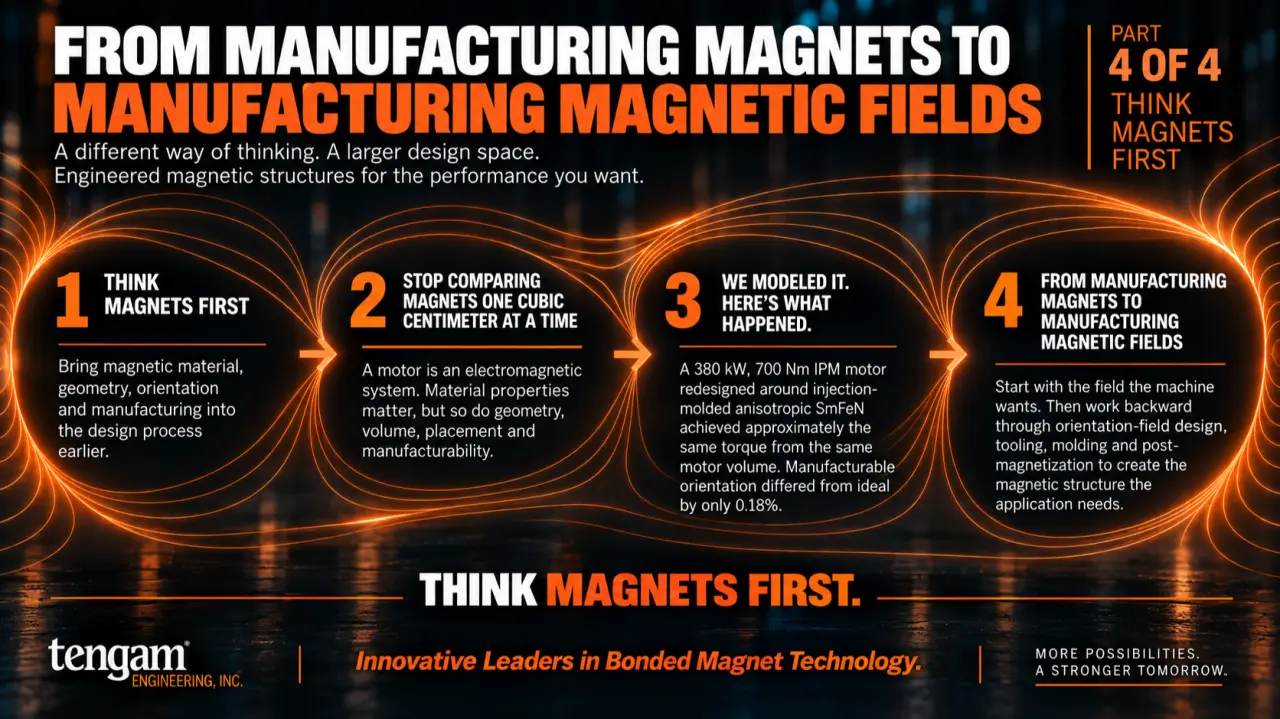
In Part 1, I proposed that we THINK MAGNETS FIRST.
In Part 2, I challenged the idea of comparing permanent magnets ONE CUBIC CENTIMETER AT A TIME.
In Part 3, we looked at what happened when a 380 kW, 700 Nm IPM MOTOR was redesigned around INJECTION MOLDED ANISOTROPIC SmFeN rather than simply substituting one magnetic material for another.
PART 4 OF 4 — THINK MAGNETS FIRST From Manufacturing Magnets to Manufacturing Magnetic Fields. This may ultimately be the larger opportunity.
The motor redesign discussed in Part 3 raised practical question: Can we manufacture it? That example examined a 380 kW, 700 Nm IPM motor redesigned around injection-molded anisotropic SmFeN. Its potential depended on designing for the material and process together, an approach that could give electromagnetic engineers more influence over how magnetic structures are made.
This series began with a proposal to “think magnets first” and challenged the practice of comparing permanent magnets one cubic centimeter at a time. The manufacturing question takes that argument further. An engineer may identify a desired magnetic field, only to have to approximate it with rectangular magnets or an assembly of individually manufactured segments. Anisotropic injection molding offers a way to bring the manufactured structure closer to the electromagnetic design.
The process begins with finite element analysis to determine the desired magnetic geometry and orientation. Magnetic analysis then establishes how to produce the required orientation field during molding, and the tooling applies that field while the anisotropic magnetic material is mobile. As the material cools, the particle orientation becomes fixed within the component. A subsequent magnetization step establishes the final magnetic state. This sequence allows geometry and particle orientation to be developed together around the application.
At Tengam Engineering, our work provides a manufacturing basis for exploring that approach. We have decades of experience injection molding permanent magnets and have demonstrated insert-loaded lamination-stack molding and single-shot magnetic components using up to 1,500 grams of magnetic compound. For IPM assemblies, we have molded complete magnetic assemblies in approximately 50 seconds.
Conventional production can involve manufacturing individual magnets, grinding them to tolerance, magnetizing and handling them, then positioning, inserting, bonding and retaining them in an assembly. Injection molding can consolidate parts of that chain. The potential extends beyond cycle time, however, molding gives engineers opportunities to develop magnetic geometries and particle orientations that would be difficult to achieve with discrete magnets.
That is the practical meaning of “think magnets first.” Magnetic material, geometry, orientation and manufacturing process need to enter the design discussion early enough to influence the motor topology. Selecting a magnet after the basic architecture has been established leaves much of that opportunity unexplored.
For more than four decades, NdFeB has enabled extraordinary advances in permanent-magnet motors. Research into stronger, less expensive and more secure magnetic materials should continue. Alongside that work, existing materials and manufacturing processes deserve attention for the design freedom they may offer beyond conventional sintered magnets.
At Tengam, we are increasingly interested in what happens when the field required by the application becomes the starting point for manufacturing. The next step is to connect that electromagnetic requirement to a magnetic structure we can mold, orient and magnetize. The opportunity is to make that structure part of the machine’s design from the beginning.
#SmFeN #PermanentMagnets #ElectricMotors #MotorDesign #IPM #Magnetics #AdvancedManufacturing #Engineering #Tengam