In Part 1, I proposed that we THINK MAGNETS FIRST.
n Part 2, I challenged the idea of comparing permanent magnets one cubic centimeter at a time.
But eventually, we must answer the obvious question. Does it work?
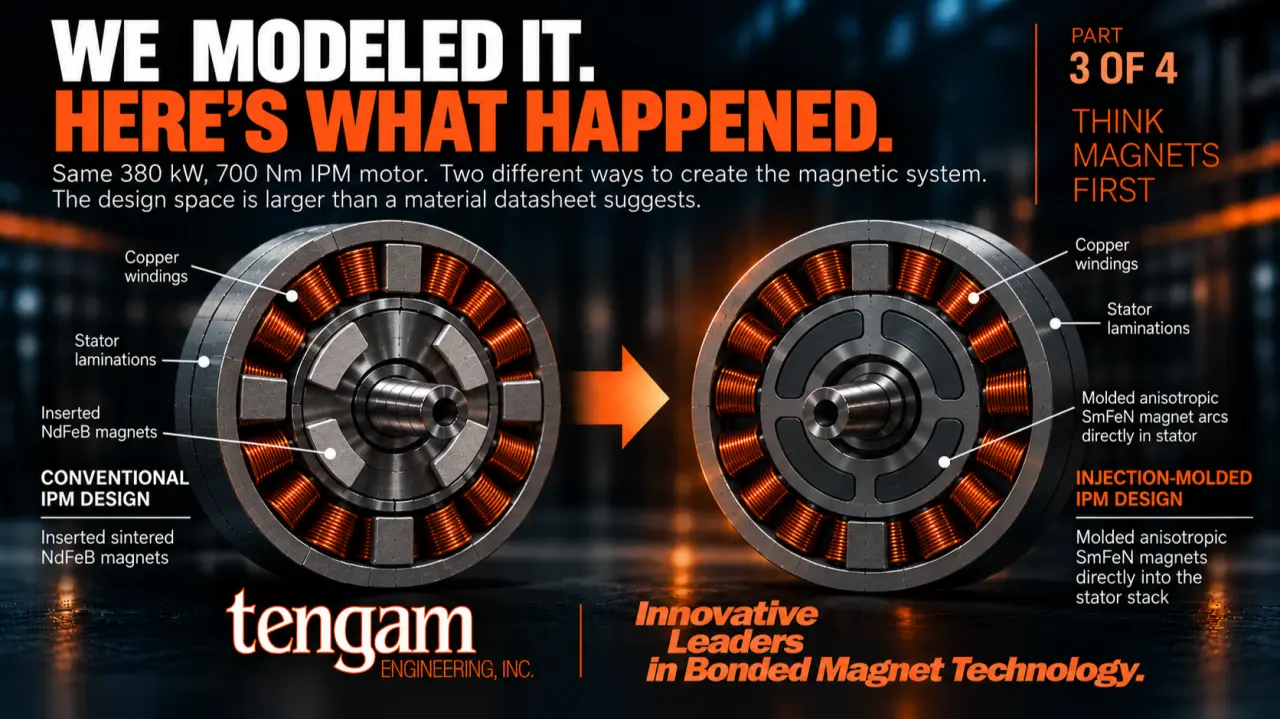
Tengam Engineering has been working with Oak Ridge National Laboratory on exactly that question. A 380 kW—approximately 500 HP—700 Nm brushless IPM motor originally optimized around high-grade sintered NdFeB magnets was redesigned using injection-molded anisotropic SmFeN.
The stator architecture was retained, and we designed the rotor around the capabilities of the molded magnetic material. The result? Approximately the same 700 Nm torque from the same overall motor volume. The SmFeN design required approximately 1.95 times the magnetic volume. But because of the material’s lower density, magnet mass increased by only approximately 30%. This is exactly why comparing magnets one cubic centimeter at a time can miss the larger engineering opportunity.
But another result may be considerably more important. An electromagnetic simulation can specify virtually any magnetic orientation. Manufacturing is another matter. For the ORNL motor study, an initially optimized magnetization orientation produced a calculated torque of 700.7 Nm
Tengam then evaluated an orientation field that could actually be created through the anisotropic injection-molding process. Calculated torque equaled 699.4 Nm. That is just a 0.18% difference. This number deserves significant attention. We didn’t simply ask what magnetic orientation produced the best result in FEA, we asked what orientation can we manufacture.
That begins to connect electromagnetic optimization directly to magnet manufacturing and that is really the premise behind THINK MAGNETS FIRST.
The analysis also revealed characteristics that would be difficult to recognize from a simple comparison of magnet datasheets. Under modeled worst-case short-circuit conditions, the NdFeB design fell to approximately 0.50 per-unit torque following irreversible demagnetization. The SmFeN designs retained approximately 0.90–0.92 per-unit torque and the mechanical analysis indicated acceptable stresses at both 5,000 and 10,000 RPM.
Was SmFeN superior in every metric? No. The average modeled drive-cycle efficiency was 89.4% for SmFeN versus 91.2% for NdFeB, although both approached 97% peak efficiency. The analysis identified field weakening in the SmFeN machine design as the source of increased high-speed loss and indicated that further optimization could better match the machine to its drive cycle.
That’s exactly what engineering development is supposed to reveal. This isn’t an argument that SmFeN automatically makes a better motor. It doesn’t. The argument is that material properties alone do not define the available motor design space. Material properties matter. So do magnetic volume, geometry, placement, orientation, demagnetization resistance and, critically, whether the magnetic structure can actually be manufactured.
We started with a 700 Nm motor designed around sintered NdFeB. We redesigned the rotor around injection-molded anisotropic SmFeN. The model gave us approximately 700 Nm. And when the theoretically optimized magnetic orientation was changed to one designed around the actual molding process, the calculated torque changed by only 0.18%.
Now comes the harder question:
Can we turn the model into a manufacturing process?
That’s where Tengam’s experience becomes important.
Part 4: Manufacturing the magnetic field.
#SmFeN #ORNL #ElectricMotors #IPM #PermanentMagnets #MotorDesign #Magnetics #Engineering #AdvancedManufacturing #Tengam